What if being open-minded about the paranormal didn't mean abandoning science, and being skeptical didn't mean dismissing experiences we can't explain? Somewhere between the people convinced that every creaky floorboard is a ghost and the people who think anything remotely supernatural is complete bullshit, there's a fascinating middle ground worth exploring. For many of us, the possibility that consciousness extends beyond what we currently understand is equal parts intriguing, comforting, and existentially unsettling. And while we might enjoy a good ghost story, there's something deeper behind our fascination with the paranormal: a desire to understand the mysteries of human experience, especially the ones that challenge our assumptions about reality.
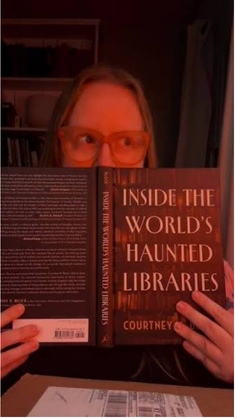
On this episode of But For Real, therapists Valerie Martin and Emerson Ryder are joined by author and librarian Courtney M. Block for a conversation about paranormal research, scientific skepticism, haunted libraries, and the psychology of unexplained experiences. Courtney is an instruction, reference, and user engagement librarian at Indiana University Southeast and the author of several books, including Inside the World's Haunted Libraries, The Encyclopedia of Parapsychology, and Researching the Paranormal. Her work focuses on helping people navigate the often-misunderstood world of paranormal research and distinguish credible information from sensationalized claims. Together, we explore what it means to approach extraordinary experiences with curiosity, intellectual humility, and a healthy appreciation for evidence.
Can You Believe in Science and Still Be Curious About the Paranormal?
One of the most interesting tensions surrounding paranormal phenomena is the assumption that scientific thinking and openness to the unexplained are fundamentally incompatible. If you identify as a rational, evidence-driven person, admitting that you're curious about ghosts, near-death experiences, or extrasensory perception can feel surprisingly vulnerable. There's a social stigma attached to these interests, particularly in academic and scientific communities, where even asking questions about certain subjects can be interpreted as a lack of critical thinking. But there's a pretty significant difference between claiming something is objectively true and being willing to investigate whether it might be.
During our Step Into My Office segment, we respond to a listener who feels caught between two extremes: people who enthusiastically believe just about everything paranormal and people who dismiss the entire subject without considering the evidence. Courtney offers a perspective that applies far beyond ghost stories, reminding us that two seemingly contradictory things can be true at once. We can value scientific rigor while acknowledging that there are aspects of human experience we don't fully understand, and we can take people's experiences seriously without automatically accepting their interpretations of those experiences. In fact, the willingness to question our own assumptions, including skeptical ones, is an essential part of genuinely open-minded inquiry.
This is also where the psychology of social belonging comes into play, because our willingness to explore unfamiliar ideas is often shaped by how safe we feel discussing them with the people around us. Emerson reflects on her own tendency to approach certain spiritual experiences with skepticism, recognizing that dismissiveness can sometimes be a response to discomfort rather than a carefully considered intellectual position. Val also points out that we don't necessarily need every friend to share our interests or engage meaningfully with every part of our inner world. Sometimes finding a community where we can ask unconventional questions without being immediately judged is an important part of feeling understood.
What Does Paranormal Research Actually Look Like?
Although paranormal investigation has become practically synonymous with television ghost hunters, dramatic sound effects, and questionable electronic gadgets, the academic study of unusual phenomena has a much longer and more complicated history. Courtney explains that modern parapsychological research has roots in the spiritualist movement of the nineteenth century, when séances, mediums, and purported communication with the dead attracted widespread public attention. Scientists and scholars became interested in investigating these claims, including identifying the fraud and theatrical deception that were undeniably present in the movement. Rather than simply accepting extraordinary stories at face value, researchers began asking how such experiences could be systematically examined.
Today, parapsychology encompasses research into subjects such as extrasensory perception (ESP), anomalous cognition, and certain experiences associated with consciousness and death. Courtney emphasizes the importance of examining research methods, transparency, statistical analysis, and peer review rather than dismissing a study solely because its subject matter seems unusual. Of course, the existence of published research does not automatically establish that a paranormal phenomenon is real, just as peer review doesn't guarantee that a study's conclusions are correct. The broader scientific acceptance of particular findings depends on the quality, reproducibility, and cumulative strength of the evidence, and many paranormal claims remain highly contested.
An especially useful takeaway from this conversation is that intellectual consistency matters. If we're going to question the credibility of research investigating unusual phenomena, we should apply the same critical standards we use when evaluating studies in psychology, medicine, or other scientific fields. That means looking beyond provocative headlines to examine how a study was designed, what its actual findings suggest, and whether alternative explanations have been adequately considered. It also means recognizing that the absence of a satisfying explanation isn't necessarily evidence of a supernatural one, even when an experience feels extraordinary.
The Psychology of Unexplained Experiences
As therapists, Val and Emerson have encountered people whose experiences don't fit neatly into familiar explanations, whether that involves an unusual dream, a powerful sense of connection after a loved one's death, or an event that feels impossible to account for. These experiences can be profoundly meaningful, particularly when they intersect with grief, spirituality, identity, and our understanding of mortality. Yet people are often hesitant to share them because they fear being judged, pathologized, or dismissed as irrational. That fear can add another layer of isolation to an experience that may already be difficult to process.
Courtney speaks about the importance of respecting people's lived experiences without insisting that we know exactly what caused them. Someone might describe seeing an apparition or sensing a deceased loved one's presence, but acknowledging the sincerity and emotional significance of that report doesn't require us to declare that a ghost was objectively present. This distinction is particularly important in mental health conversations, where compassionate listening and careful assessment can coexist. We don't have to choose between unquestioning validation of every interpretation and a reflexive attempt to explain away anything that falls outside our usual worldview.
The conversation also touches on near-death experiences, which are especially compelling because they raise questions about consciousness, perception, and what happens when the brain undergoes extreme physiological stress. Val reflects on accounts from people who describe these experiences as feeling more real than ordinary waking life, even when they previously held skeptical beliefs. There are proposed neurological and physiological explanations for aspects of near-death experiences, but the subjective intensity and personal meaning of these accounts remain important areas of inquiry. The larger question isn't simply whether a particular supernatural explanation is correct, but how we understand experiences that can profoundly change someone's relationship with life and death.
Why Are Libraries So Haunting?

Of course, we couldn't have a conversation with the author of Inside the World's Haunted Libraries without asking what makes libraries such compelling settings for ghost stories. Courtney suggests that libraries possess an inherently haunting quality, not necessarily because they're filled with spirits, but because of the unusual relationship between people, places, memory, and time. Like museums, airports, and other spaces where people continuously come and go, libraries hold countless overlapping histories and human experiences. There's something evocative about standing in a quiet room surrounded by objects that have passed through the hands and lives of people we'll probably never meet.
Books themselves add another dimension to this idea, functioning as physical artifacts of human creativity and consciousness. A single library book might spend years moving between homes, carrying stories that evoke vastly different emotions and interpretations for every person who reads it. Courtney describes these books as almost ritualistic objects, repeatedly circulating through personal spaces before returning to their shelves. It's a beautiful way of thinking about literature as something more than information, and about libraries as places where traces of human experience continually accumulate.
Courtney also describes libraries as deeply liminal spaces, occupying an unusual position between the public and the personal, the familiar and the mysterious. They provide access to knowledge and resources regardless of a person's income, social status, or background, making them uniquely democratic institutions in a society where so much access is determined by privilege. At the same time, they're places where we encounter other people's thoughts, histories, imaginations, and questions about existence. Whether or not you believe in literal hauntings, it's easy to understand why a quiet library can inspire both comfort and an eerie sense of wonder.
Curiosity, Skepticism, and Making Peace With Not Knowing
Perhaps the most meaningful thread running through this episode is our relationship with uncertainty, which is something humans are notoriously uncomfortable navigating. We like explanations, categories, and conclusions because they provide a sense of predictability and control over a world that frequently reminds us how little control we actually have. When we encounter something that challenges our understanding of reality, there's an understandable temptation to resolve that discomfort as quickly as possible. For some people, that means embracing a paranormal explanation, while for others, it means dismissing the experience entirely.
But what happens when we allow ourselves to stay curious without demanding immediate certainty? We create space to investigate, to question our assumptions, and to consider perspectives that don't fit neatly into our existing beliefs. We also become better equipped to listen to other people's experiences without making the conversation a referendum on their intelligence or credibility. In many ways, this is the same intellectual and emotional flexibility we try to cultivate in therapy: the ability to hold complexity without feeling compelled to reduce everything to a tidy answer.
This doesn't mean that every theory deserves equal credibility or that critical thinking should take a back seat to personal intuition. It means being thoughtful about how we evaluate evidence while remaining aware of the limitations of our own knowledge. Courtney's approach offers an alternative to both sensationalized paranormal content and reflexive skepticism, inviting us to take unusual questions seriously without pretending they've all been answered. And there's something genuinely refreshing about making room for mystery in a culture that often rewards certainty, confidence, and having an immediate opinion about absolutely everything.
What Exploring the Paranormal Can Teach Us About Being Human
Ultimately, this conversation is about much more than haunted libraries or whether ghosts actually exist. It's about how we respond to experiences that challenge our worldview, how we navigate the tension between scientific understanding and subjective meaning, and how our desire for certainty shapes the way we relate to one another. These questions connect naturally to psychology, grief, spirituality, and the search for meaning that accompanies the whole complicated business of being human. Whether you consider yourself a paranormal enthusiast, a committed skeptic, or someone who hasn't quite figured out where you stand, there's value in approaching these topics with both curiosity and discernment.
We don't need to believe every unexplained story, and we certainly don't need to abandon evidence-based thinking to appreciate the mysteries of consciousness and human experience. But we also don't have to treat someone's curiosity about those mysteries as an intellectual or psychological failing. Sometimes the most interesting conversations begin when we're willing to admit that we don't have all the answers, and that investigating the questions might be worthwhile anyway. If you're ready to explore the weird, wonderful, and occasionally spooky intersection of science, psychology, and the paranormal, join Val, Em, and Courtney for this episode of But For Real.
Listen to the full episode of But For Real with Courtney M. Block for more on paranormal research, unexplained experiences, haunted libraries, and how to be both scientifically skeptical and genuinely open-minded.