
Can You Actually Train Your Brain? The Science Behind Brain Mapping and Neurofeedback - But For Real podcast #55
What qEEG, neurofeedback, and neuromodulation can (and can't) tell us about mental health—with guest Cory Williams.

If you've spent approximately 30 seconds on the wellness side of the internet lately, you've probably been told you need to "rewire your brain," "regulate your nervous system," or "heal your neural pathways." And listen, we're all for neuroplasticity. The fact that our brains can change and adapt throughout our lives is genuinely fascinating, and it's one of the many reasons neuroscience is such an exciting field. But when someone starts talking about putting electrodes on your head to measure your brain activity, identify potential mental health concerns, and help your brain function differently, it's reasonable to have a few questions.
Like… is this legitimate neuroscience, or am I about to accidentally join a cult? It's a fair question, particularly in a wellness industry where scientific language and questionable marketing claims are often getting a little too cozy with each other. We hear so much about "brain hacks" and nervous system optimization that it can be difficult to distinguish genuinely promising interventions from the latest expensive wellness trend. And when you're already struggling with your mental health, the promise of something that could finally make a difference can be especially compelling.
In this episode of But For Real, therapists Valerie Martin and Emerson Ryder sit down with Cory Williams, a specialist in neurofeedback and functional neurodiagnostics, to explore what happens when we start looking at mental health through the lens of actual brain activity. Cory began his career as a teacher before transitioning into neurofeedback and brain-based interventions. Today, his work includes quantitative electroencephalography (qEEG), biofeedback, neurofeedback, and neuromodulation—approaches that use physiological information to better understand and potentially influence how our brains and bodies function. And while some of those terms might sound like something out of a sci-fi movie, the conversation is surprisingly accessible.
First Things First: WTF Is Brain Mapping?
Most of us are familiar with the idea of going to therapy and talking through our experiences, emotions, relationships, and behavioral patterns. But what if we could also gather information about the electrical activity happening in our brains? That's essentially the idea behind qEEG brain mapping, an approach that uses measurements of brain activity to examine patterns that may be relevant to neurological and psychological functioning. Rather than relying exclusively on what someone reports about their internal experience, qEEG offers an additional source of physiological information that may help inform clinical questions.
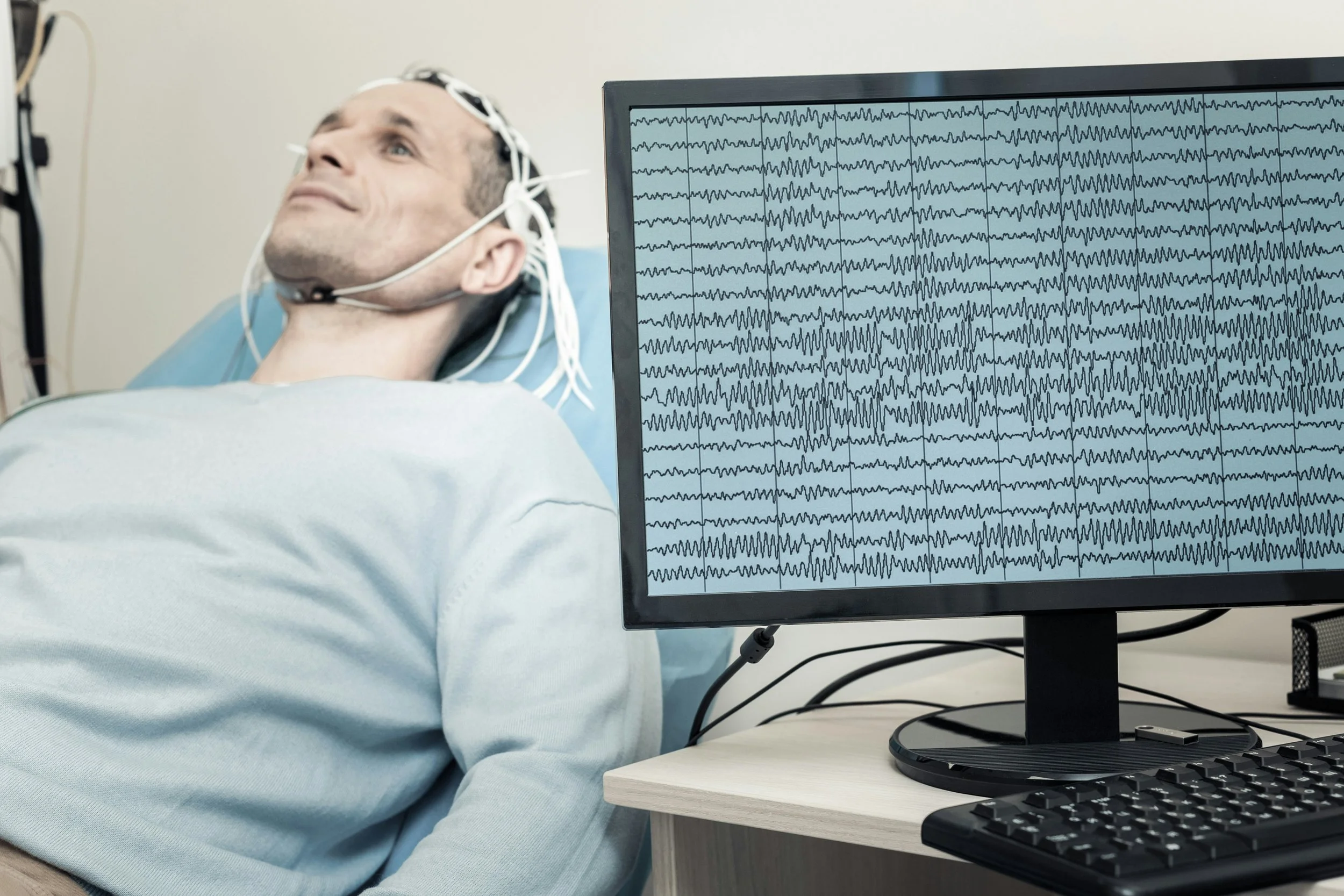
An electroencephalogram (EEG) measures electrical activity in the brain using electrodes placed on the scalp. A quantitative EEG, or qEEG, takes that recorded activity and uses statistical analysis to examine patterns in the data. Importantly, a qEEG isn't reading your thoughts, and it certainly doesn't know what embarrassing thing you said in seventh grade that you're still thinking about at 2 a.m. (Unfortunately, you're still on your own with that one.) Instead, it examines different patterns and frequencies of electrical activity that may offer useful information about how the brain is functioning.
Cory explains that his assessment process includes looking at the raw EEG recording, analyzing patterns of activity, and comparing the results with a reference database. One part of this process involves what's called a normative comparison, which examines how someone's brain activity compares with patterns observed in a screened reference population. These comparisons can help identify statistically unusual patterns, although unusual doesn't necessarily mean clinically significant. Interpreting what those findings might mean requires considerably more context than simply looking at which parts of a brain map are highlighted in different colors.
And because we're The Gaia Center, we can't just skip over the word "normative" without acknowledging how loaded the concept of normal can be. Cory actually shares that he dislikes the term himself, which opens up an important question about what we're measuring and why. Human brains vary enormously, and difference doesn't automatically mean dysfunction, particularly when we're discussing neurodivergence, disability, and the long history of treating departures from the statistical average as problems that need fixing. A brain map is information, not a moral judgment, a measure of someone's worth, or a complete explanation of who they are. Nor should it be treated as a stand-alone psychiatric diagnosis.
So, What Actually Happens During a qEEG Assessment?
Here's the good news: nobody is drilling into your skull, and the assessment itself is considerably less dramatic than its name might suggest. In Cory's practice, the process involves placing electrodes on the scalp using a conductive gel that helps capture electrical signals. After setup, the client spends approximately 10 minutes with their eyes open and another 10 minutes with their eyes closed. Cory estimates that the appointment typically takes around 40 minutes, meaning the recording process is relatively straightforward even if the technology behind it is pretty sophisticated.
The more complicated work happens afterward, when the recorded data needs to be reviewed and analyzed. EEG recordings can contain electrical signals that aren't actually coming from the brain, including activity caused by eye movements, blinking, swallowing, and muscle tension. These are called artifacts, and they have to be identified and addressed before the data can be meaningfully interpreted. Once the recording has been reviewed, the clinician can begin examining patterns that might be relevant to the person's symptoms, medical history, or treatment goals.
One important distinction that comes up throughout this conversation is the difference between identifying a potentially meaningful pattern and actually diagnosing a condition. A particular finding might be associated with certain symptoms or clinical presentations, but that doesn't mean everyone with that finding has the same diagnosis. Nor does it mean that someone with a particular diagnosis will necessarily show that pattern on a qEEG. Like most clinical tools, brain mapping is most useful when its findings are interpreted alongside a broader understanding of the person rather than being treated as a magical window into their psychological life.
Can Brain Mapping Help With ADHD, Anxiety, or Depression?
One of the most interesting parts of our conversation with Cory is how brain mapping might contribute to mental health treatment planning. When someone experiences difficulties with attention, emotional regulation, sleep, or mood, there can be multiple possible explanations for what they're experiencing. Two people might report remarkably similar symptoms while having very different underlying needs, histories, and contributing factors. This is one reason thoughtful mental health assessment involves so much more than matching a few symptoms to a diagnostic checklist.
Cory describes how examining EEG activity can sometimes reveal findings that warrant further medical investigation. For example, certain unusual electrical patterns may prompt a referral to a neurologist for additional evaluation, particularly when there are questions about possible neurological concerns. This matters because treating symptoms without considering other contributing factors can mean missing an important part of the clinical picture. Of course, these decisions still require appropriate medical assessment, and qEEG findings alone cannot establish the presence of a neurological or psychiatric disorder.
He also discusses his interest in using qEEG information to help inform psychiatric medication decisions, which is an understandably appealing possibility. Anyone who has spent time trying to find an effective mental health medication knows that the process can involve frustrating amounts of trial and error, with plenty of waiting, adjusting, and hoping that the next option might be a better fit. Cory sees EEG information as a potential additional piece of that decision-making process, offering another way to think about individual differences in brain functioning. However, it's important to distinguish that clinical perspective from what the research has firmly established: qEEG is not currently a validated, routine test for determining which psychiatric medication will work best for an individual, and it shouldn't replace a thorough clinical assessment or medical decision-making.
Ultimately, the value of gathering more information depends on how thoughtfully that information is interpreted and used. More data doesn't automatically mean better care, especially if the findings are presented with more certainty than the evidence supports. The most useful question may be whether additional physiological information can help a qualified treatment team better understand a particular person's needs and make more informed decisions. That's a very different proposition from claiming that a brain scan can definitively tell you what's "wrong" with someone or exactly how to fix it.
Neurofeedback: Can You Literally Train Your Brain?
Okay, now we get to the really interesting part, because measuring brain activity is one thing, but what about actually changing it? Enter neurofeedback, a type of biofeedback that uses information about brain activity to help people practice changing certain patterns of neural functioning. Despite how futuristic that sounds, the underlying concept is relatively straightforward: provide the brain with feedback about what it's doing and use that information as part of a learning process. In theory, repeated practice may help someone become better able to produce or maintain particular patterns of activity associated with their treatment goals.
Cory describes an example in which someone watches a television screen while sensors monitor their brain activity. As their activity moves toward a targeted pattern, the screen becomes brighter; when it moves away from that pattern, the screen becomes darker. Essentially, the person receives feedback about their brain activity in real time, without necessarily having to understand or consciously control the processes being measured. Think of it as a kind of learning process, except instead of practicing your tennis serve or learning a new chord on the guitar, you're receiving feedback about neurological activity that normally happens outside your conscious awareness.
The broader concept behind this approach is neuroplasticity, which refers to the nervous system's ability to change and adapt in response to experience. We know that learning and repeated experiences can influence how neural systems function, and neurofeedback attempts to use that capacity in a structured therapeutic setting. However, neuroplasticity is an incredibly broad phenomenon, and its existence doesn't automatically establish that every intervention claiming to harness it is effective. That's an important distinction in a marketplace where nearly anything can be advertised as "rewiring your brain" if you sprinkle enough scientific vocabulary into the sales copy.
But Does Neurofeedback Actually Work?
Cory discusses neurofeedback's use for concerns including ADHD, anxiety, depression, PTSD, insomnia, and other difficulties. He also describes a framework that ranks the strength of evidence for different applications, emphasizing that not all uses have been studied to the same extent. There is certainly research worth paying attention to, including studies that have found benefits for particular populations or outcomes. However, the overall evidence varies depending on the condition, the specific neurofeedback protocol, and the methodological quality of the studies being examined.
For ADHD in particular, neurofeedback has been studied extensively, but questions remain about the magnitude, consistency, and durability of its effects. Some studies report promising improvements, while others have not consistently demonstrated benefits beyond comparison treatments, especially when outcomes are evaluated using more rigorous or blinded measures. That's not a reason to dismiss the entire field, but it is a reason to approach the claims with the same critical thinking we should apply to any mental health intervention. There's a meaningful difference between a treatment having a plausible scientific mechanism, producing encouraging preliminary results, and having enough high-quality evidence to recommend it as a standard treatment.
This distinction matters because people seeking mental health treatment are often doing so from a place of considerable vulnerability. They may have already tried multiple approaches without finding the relief they hoped for, and the promise of something innovative can feel like a lifeline. Ethical treatment discussions should leave room for both possibility and uncertainty rather than presenting emerging interventions as guaranteed solutions. Being excited about the potential of neurofeedback and being appropriately skeptical of overly confident claims are not mutually exclusive positions.
Neurofeedback vs. Neuromodulation: What's the Difference?
Another topic Cory helps unpack is neuromodulation, a broader category of interventions designed to directly influence nervous system activity. While neurofeedback involves providing information about brain activity so the person can learn to alter certain patterns, neuromodulation uses an external intervention to affect neural functioning. These approaches can involve different technologies and mechanisms, which means it's important not to treat them all as interchangeable. The terminology can get confusing quickly, particularly when commercial wellness marketing tends to group a wide range of devices under the general umbrella of "brain optimization."
One approach Cory discusses is transcranial electrical current stimulation, which uses small electrical currents applied through electrodes on the scalp. He describes the sensation as mildly itchy or tingly, and one teenage client apparently compared it to how Rice Krispies sound. Which, quite frankly, is both incredibly specific and weirdly helpful. But beyond the sensory experience, it's important to understand that these interventions differ in their intended effects, supporting evidence, safety considerations, and clinical applications.
Some brain stimulation treatments have well-established medical uses, while others remain experimental or have limited evidence for particular mental health concerns. Even approaches that sound similar may have significantly different regulatory statuses or levels of scientific support, depending on the device and how it's being used. If you're considering one of these interventions, understanding the specific treatment being offered matters at least as much as knowing the broader category it falls into. "Brain stimulation" is not a one-size-fits-all treatment, and it certainly doesn't mean every device marketed for nervous system healing has been proven effective.
What Does Success Actually Look Like?

One of the more poignant moments in the episode comes when Cory shares the story of a young client who had experienced significant difficulties with sensory processing, auditory processing, and trauma-related concerns. After completing 40 sessions, Cory describes changes that went well beyond abstract measurements of brain activity. She was spending more time with friends, going on dates, attending concerts, and watching movies with her family. In other words, she was becoming more engaged in the ordinary experiences of being a young adult, which can be a profoundly meaningful shift for someone whose symptoms have interfered with daily life.
Of course, an individual success story can't establish that a treatment will work for everyone or prove exactly what caused the improvement. Anecdotes can help us understand what a positive outcome might look like, but they don't replace controlled research examining effectiveness, possible harms, and how treatment compares with other options. Still, stories like this highlight something important about how we should think about mental health outcomes. The point isn't necessarily to make a brain scan look prettier; the point is to improve someone's actual experience of living.
Can someone participate in relationships more comfortably, engage in activities they enjoy, or navigate daily life with less distress? Are they sleeping better, experiencing greater emotional flexibility, or feeling more connected to the people around them? These are the kinds of changes that can make an enormous difference in someone's quality of life, even when they aren't particularly exciting to describe in technical language. Whether we're talking about psychotherapy, psychiatric medication, neurofeedback, or another intervention, meaningful improvement should be evaluated in terms of the person's actual wellbeing and functioning—not just a set of measurements.
Before You Pay Someone to Rewire Your Brain, Ask These Questions
As interest in nervous system regulation and brain-based treatments grows, so does the marketplace for services promising to optimize, retrain, or transform our brains. Some providers have extensive training and use carefully developed assessment and treatment protocols, while others may be considerably less qualified than their websites suggest. The wellness industry has never been particularly shy about borrowing the language of science to market products and services, and neuroscience is especially vulnerable to this because so many of us find the subject both fascinating and difficult to understand. When we're talking about interventions involving brain activity, qualifications and transparency are not minor details.
Cory emphasizes the importance of researching practitioner qualifications and identifies two professional organizations that offer relevant certifications: the Biofeedback Certification International Alliance (BCIA) and the International QEEG Certification Board. He discusses his certifications through both organizations and his involvement with the qEEG certification board, along with the importance of appropriate training in this field. Professional credentials can be useful indicators of specialized education and experience, although they don't automatically establish that every treatment a provider offers is evidence-based. It's still worth asking specific questions about the intervention being recommended and why it's considered appropriate for your particular circumstances.
If you're exploring neurofeedback or brain mapping, there are several questions worth asking before committing to treatment:
What specific qualifications, training, and certifications does the provider have?
What evidence supports this particular treatment for the concerns I'm experiencing?
Is the qEEG being used as one part of an assessment, or is someone claiming it can definitively diagnose a mental health condition?
What are the potential risks, side effects, and limitations?
How many sessions are recommended, and what will the total cost look like?
How will we evaluate whether treatment is actually helping?
Will the provider coordinate with my therapist, psychiatrist, or other healthcare professionals when appropriate?
And perhaps most importantly, what happens if it doesn't work? An ethical provider should be able to discuss realistic expectations, limitations, and alternative treatment options without getting defensive or promising miraculous outcomes. Ideally, you should leave an initial consultation feeling more informed about your choices rather than pressured to purchase an expensive package of sessions. Being curious about emerging treatments doesn't require abandoning discernment, and you can absolutely be open-minded and appropriately skeptical at the same time. We contain multitudes, baby!
The Bigger Picture: Your Brain Is Part of You, Not All of You
One thing we appreciate about exploring brain-based interventions is that they challenge the idea that emotional suffering exists exclusively in our conscious thoughts. As therapists, we regularly work with people who intellectually understand their patterns but still find themselves having powerful emotional and physiological reactions. They know why they feel anxious, understand their attachment patterns, and can explain the origins of their coping strategies with the detail and accuracy of someone presenting a doctoral dissertation. And yet, their bodies didn't necessarily get the memo, which is one reason approaches that extend beyond conscious insight can be worth exploring.
There are good reasons to be interested in interventions that work with processes beyond conscious thought, including physiological arousal, attention, and emotional regulation. But there's another side to this conversation that we don't want to lose, particularly given how easily mental health discussions become overly focused on what's happening inside the individual. Our brains don't exist in a vacuum, and our psychological wellbeing cannot be understood exclusively through neural activity. Our mental health is also shaped by relationships, environments, identities, experiences, access to resources, and the broader social and political systems in which we live.
You can work on attention, emotional regulation, or physiological arousal and still be living in circumstances that are genuinely stressful, unsafe, or oppressive. A brain-based intervention cannot eliminate systemic injustice, repair a harmful relationship, or magically create the material conditions people need to thrive. And we should be wary of treating every understandable response to a difficult world as evidence of a defective nervous system, particularly when the language of regulation and optimization can imply that the primary problem is always located within the person. Sometimes distress is communicating something important about our environments, relationships, or circumstances, and not simply reflecting a physiological process that needs to be corrected.
The most useful approaches to mental health care recognize that biology, psychology, relationships, and social context all matter, even if different modalities emphasize different parts of that picture. Brain mapping and neurofeedback may offer helpful additional tools in certain circumstances, but they are not replacements for seeing and understanding the whole person. This is especially important when working with people who have already experienced pathologizing or invalidating care, or whose symptoms have been separated from the contexts in which they developed. A truly integrative approach should expand our understanding of someone's experience rather than reducing their humanity to a collection of neurological measurements.
The Bottom Line: Your Brain Can Change, But Beware the Hype
Perhaps the most exciting thing about neuroscience isn't the possibility of finding a perfect brain hack, but the recognition that our brains are dynamic. Learning, experience, relationships, environments, and repeated behaviors can influence how neural systems function over time, which offers meaningful possibilities for growth and adaptation. But that doesn't mean every claim about "rewiring" has scientific support, or that everyone needs neurofeedback to improve their mental health. It definitely doesn't mean your brain is broken because you're anxious, depressed, distracted, or struggling to function under profoundly stressful circumstances.
What it does mean is that there's still a great deal to learn about how our brains work and how different forms of treatment might support mental health and wellbeing. Cory brings an enthusiastic, practitioner-focused perspective to this conversation, and Val and Emerson explore both the possibilities and the important questions that come with it. Whether you're a therapist curious about incorporating additional assessment tools, someone navigating ADHD or anxiety, or simply a giant neuroscience nerd (welcome, you're among friends), this episode offers plenty to think about. Understanding our brains can be fascinating and useful without turning neuroscience into another self-improvement religion in the process.
Disclaimer: This article and the But For Real podcast are intended for educational and entertainment purposes and are not substitutes for individualized mental health or medical care. If you're considering neurofeedback, qEEG assessment, or neuromodulation, consult appropriately qualified healthcare professionals to discuss the evidence, risks, and suitability for your specific needs.