
By Jenna Dalfino, Graduate Intern
There is a kind of grief we don’t talk about enough—the grief of who you used to be.

Not the dramatic, cinematic loss. Not the kind that arrives with casseroles and sympathy cards. But the quiet, persistent grief of waking up in a body that no longer behaves the way it once did. The grief of realizing your energy, your pace, and even your sense of self has shifted.
When you live with chronic illness, disability, or long-term health changes, grief doesn’t always come from what you lost, but from who you were before you knew loss like this existed. And that grief deserves language, space, and legitimacy.
The Invisible Loss of the “Before” Self
Many people expect grief to follow death, breakups, or major life events. Fewer expect it to follow a diagnosis. And yet, chronic illness often initiates a series of endings: the end of spontaneity, the end of trusting your body without question, the end of certain futures you assumed were guaranteed.
You may grieve:
The body that didn’t require constant monitoring
The version of yourself who could push through exhaustion
The identity built around productivity, achievement, or caretaking
The sense of safety that came from believing your body was reliable
What makes this grief especially complex is that the “before” self isn’t entirely gone. You still recognize parts of them. You remember their habits, their dreams, their confidence, the way their body moved and looked, and perhaps parts of them are still with you still today; although not in the same way. That can make the grief feel confusing, disorienting—sometimes even disloyal.
Naming Body Grief
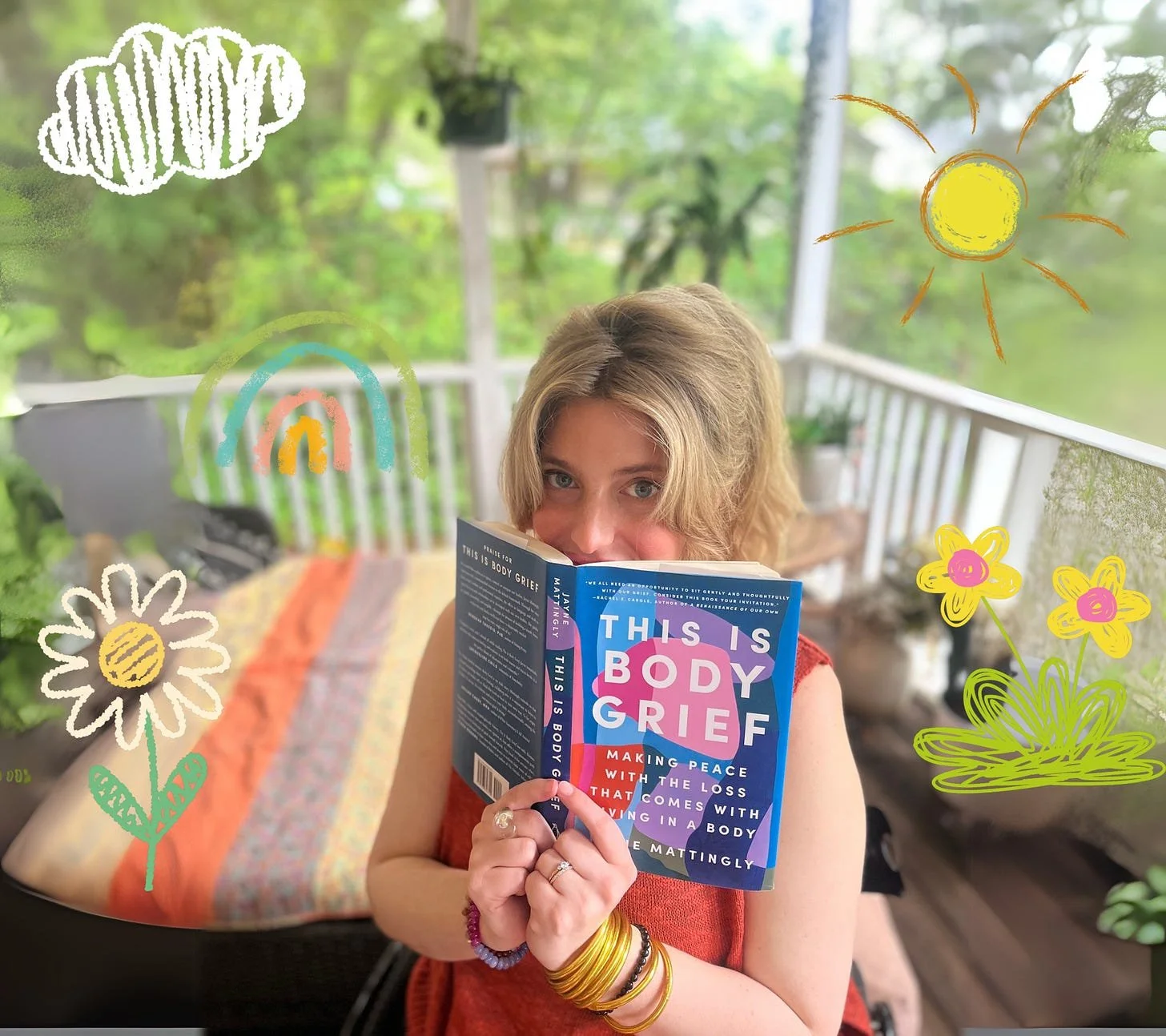
Jayne Mattingly, a disability advocate and eating disorder recovery coach, gives language to this experience through the concept of body grief—the grief that arises when our relationship with our body fundamentally changes. Body grief acknowledges that our bodies are not just physical vessels; they are integral to our identity, autonomy, and sense of belonging in the world.
Body grief isn’t about hating your body or rejecting it. It’s about mourning the rupture in trust. The loss of predictability. The reality that your body may now require accommodation, gentleness, or advocacy—sometimes all at once.
Mattingly emphasizes that body grief is not linear. It can resurface during flare-ups, medical appointments, social comparisons, or moments when your limitations are made visible. You don’t “get over” body grief; you learn how to carry it without letting it define your worth.
This reframing matters—especially in a culture that rushes people toward acceptance without honoring the grief that precedes it.
When Identity and Illness Collide
Chronic illness doesn’t just affect how you feel physically—it disrupts how you understand yourself.

If you were the dependable one, illness may force you to ask for help.
If you were the achiever, illness may slow your pace.
If you were the caretaker, illness may require you to receive care instead.
These shifts can provoke shame, anger, and deep existential questions:
Who am I if I can’t do what I used to do?
Who am I when my body sets the limits instead of my ambition?
For many, identity grief is compounded by social messaging that equates worth with productivity. Rest becomes moralized. Limitations are misunderstood. And grief is often minimized with phrases like “At least it’s not worse” or “You’re so strong.”
Strength, in this context, is not endurance at all costs. Strength is telling the truth about what hurts.
One of the most invalidating experiences for chronically ill people is the expectation to remain optimistic, grateful, or resilient at all times. While hope can be meaningful, forced positivity often “erases” grief.
You are allowed to miss your old body.
You are allowed to feel angry about what changed.
You are allowed to grieve without needing to pretend like everything is fine.
You are allowed to be weak and drop the “so brave and strong.”
Grief that isn’t acknowledged doesn’t actually disappear. When it has no where else to go, It lodges itself in the nervous system. Often this only perpetuates the cycle of stress and can contribute to chronic illness flares. I would not go as far as to say that grief is the antidote to flares; however grief can be a doorway to opening new ways of being. Grief can be a path of expression which allows one to wonder, to explore, and to see through tears with greater clarity of who you once were and where you find yourself now.
Instead of pressured, put on strength and false positivity; dare I say: you may just find that grief feels gentle.
There is a common misconception that grieving your “before” self means you can’t also grow into a new version of yourself. In reality, both can coexist.
You can grieve who you were and discover who you’re becoming.
You can honor loss and cultivate self-compassion.
You can mourn and reimagine your life with different rhythms.
The goal is not to replace your old identity with a “better” one, but to integrate your experience into a more expansive sense of self.
One that allows for softness, limits, creativity, and truth.
Gentle Practices for Navigating Body Grief

There is no checklist for grieving your body or identity, but some practices can support the process:
Name the loss: Write or speak about what has changed. Be specific. Naming loss validates it.
Notice comparison gently: When you catch yourself comparing your present self to your past self, pause. That comparison is often a signal of grief, not failure.
Work with your body, not against it: Shift from control to collaboration. Ask: What does my body need today?
Seek spaces that understand: Support groups, therapy, or communities where disability and chronic illness are normalized can be deeply regulating.
Let advocacy be personal: You don’t owe anyone inspiration. Your needs are valid without justification.
You Are Still You Even As You Change
Grieving your “before” self doesn’t mean you’re stuck in the past. It means you are honoring the full reality of your experience. It means you are telling the truth about what chronic illness takes—and what it reshapes.
Your worth is not measured by how much you can do.
Your identity is not frozen in time.
And your grief does not make you weak—it makes you human.
As Jayne Mattingly reminds us through the lens of body grief, healing doesn’t come from pretending loss didn’t happen. It comes from being witnessed in it—from allowing our grief to be named, held, and met with honesty rather than urgency to “move on.”
You are allowed to build a life that fits the body you live in now. And that, too, is a form of resilience—one rooted not in pushing through, but in staying real with what is true, tender, and changing.
P.S. Speaking of staying real….If this reflection resonates and you’d like to sit with these ideas a little longer, I invite you to listen to But For Real, Episode 14: Body Grief & Disability Advocacy, from the But For Real podcast. In this episode, Valerie and Emerson get the opportunity to interview Jayne Mattingly and continue the conversation around chronic illness, identity, and body grief, exploring how advocacy, self-trust, and grief work intertwine when our bodies no longer follow the scripts we were given.
