
By Valerie Martin, LCSW
If you’ve ever walked away from an argument thinking, “How TF did we end up here… AGAIN?” — you’re not alone. Many couples don’t struggle because they don’t love each other. They struggle because they get stuck in predictable communication patterns that slowly wear down connection over time.
One of the most well-researched frameworks for understanding these patterns comes from the Gottman Method, developed by relationship researchers Drs. John and Julie Gottman. Their decades of research on couples identified four communication behaviors that are especially damaging when they become habitual — known as The Four Horsemen.
The good news? These patterns are common, understandable, and absolutely changeable.
Let’s break down the Gottman Four Horsemen, how they show up in relationships, and what actually helps couples move out of them.
What Are the Four Horsemen in the Gottman Method?

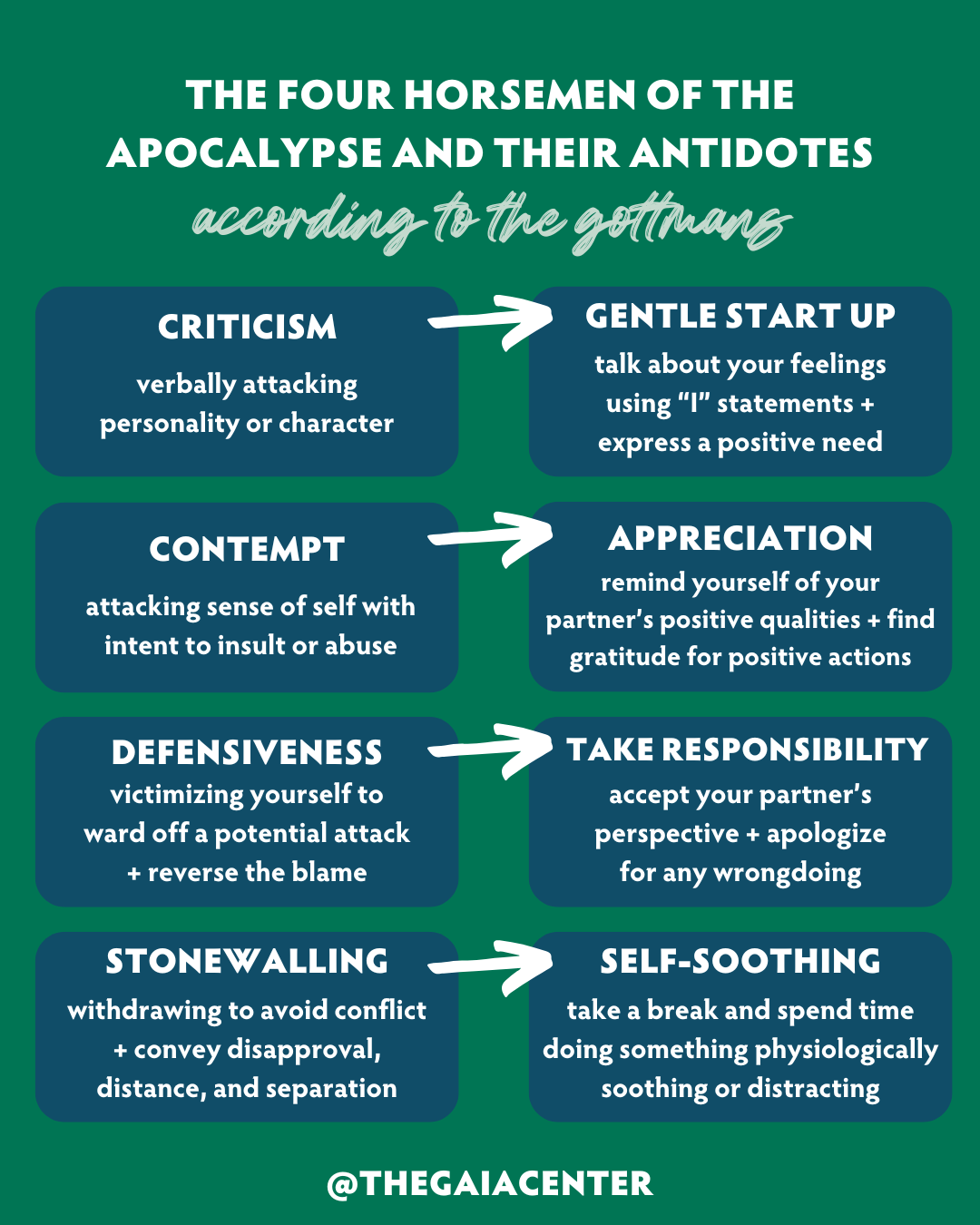
The Four Horsemen of the Gottman Method are communication styles that tend to appear during conflict and predict relationship distress when left unchecked:
Criticism
Defensiveness
Contempt
Stonewalling
Every couple experiences conflict. Even healthy, deeply connected couples occasionally hear these Horsemen clip-clopping through their conversations. The difference is that resilient couples learn to recognize the patterns early and repair them before they take over.
The goal isn’t to never fight — it’s to learn to fight well— in ways that don’t erode trust, safety, and goodwill.
Horseman #1: Criticism in Relationships

Criticism happens when a concern about behavior turns into an attack on your partner’s character or personality.
Instead of addressing what’s happening, criticism implies something is fundamentally wrong with who your partner is.
Criticism sounds like:
“You never think about anyone but yourself.”
“You’re so lazy.”
“You always mess this up.”
Why criticism escalates conflict:
Criticism triggers defensiveness almost immediately. When someone feels attacked, their nervous system shifts into protection mode — which means curiosity, empathy, and collaboration shut down.
The Gottman Antidote: Gentle Start-Ups
The Gottman Method teaches couples to replace criticism with a gentle start-up, which focuses on your feelings, the specific situation, and a clear request.
Example:
“I feel overwhelmed when dishes pile up because having a clean space helps me feel calm. I’d really appreciate it if we could clean the kitchen before bed.”
Same concern. Completely different energy.
Horseman #2: Defensiveness and Relationship Conflict

Defensiveness is a natural reaction to feeling criticized — but it tends to pour gasoline on the fire.
Defensiveness sounds like:
“That’s not true.”
“You’re overreacting.”
“Well, you do it too.”
Why defensiveness doesn’t help:
Defensiveness communicates, “The problem isn’t me — it’s you.” That blocks accountability and leaves the original issue unresolved, which means it’s likely to resurface later (usually louder).
The Gottman Antidote: Taking Responsibility
You don’t have to agree with everything your partner says to take responsibility for your part.
Example:
“You’re right — I was late, and I can see why that was frustrating. I’m sorry.”
Even small accountability— taking ownership for any part of the conflict— can dramatically de-escalate conflict, restore connection, and make defensiveness less likely.
Horseman #3: Contempt (The Most Damaging Communication Pattern)
Contempt is the most harmful of the Four Horsemen and the strongest predictor of relationship breakdown.
It includes harsh sarcasm, mockery, eye-rolling, name-calling, hostile humor, and any communication that conveys disrespect or superiority.
Contempt can come out a lot of different ways— think almost anything that’s an intentional “jab”— but here are just a few examples of what it can sound like:
“This is why no one takes you seriously.”
“You’re honestly embarrassing to be with.”
“I don’t know how someone your age can be this clueless.”
Why contempt is so damaging:
Contempt erodes emotional safety and sends the message: “I’m better than you.” Over time, it makes repair nearly impossible and leaves partners feeling unseen, unvalued, and emotionally unsafe.
The Gottman Antidote: Building a Culture of Appreciation

Contempt often grows when appreciation disappears and unmet needs pile up. One of the most powerful protective factors in relationships is a culture of appreciation.
This includes:
Expressing gratitude regularly
Naming what you admire about your partner
Noticing what they’re doing right (out loud)
It’s much harder for contempt to take root when appreciation is actively practiced.
Horseman #4: Stonewalling and Emotional Shutdown
Stonewalling occurs when one partner emotionally withdraws during conflict — shutting down, going quiet, avoiding eye contact, or disengaging entirely.
This isn’t usually intentional or manipulative. It’s often a nervous system response to feeling overwhelmed or emotionally flooded.
Why stonewalling happens:
When stress hormones spike, the brain literally loses access to problem-solving and empathy. Your prefrontal cortex, that lovely part that’s responsible for logic and reason? Yeah, she’s offline. At that point, continuing the conversation is counterproductive and can lead to real damage. We all sometimes need space or time to process before responding, but stonewalling becomes harmful when there’s no return or repair.
The Gottman Antidote: Self-Soothing and Repair
Rather than forcing the conversation, the Gottman Method encourages taking a 20-minute self-soothing break to allow the nervous system to calm — and then returning to the conversation when both partners are more regulated.
This time-out strategy is key not just with stonewalling, but when either partner starts to get physiologically flooded/dysregulated. (Which I’ll share more about in a future blog!)

How Couples Therapy Helps Break These Patterns
Understanding the Four Horsemen intellectually is one thing. Using the antidotes in the heat of the moment is another.
This is where couples therapy becomes especially helpful. Therapy provides a space to:
Slow down conflict patterns
Understand what’s happening underneath the fight
Practice new skills with real-time support
Repair past hurts that keep fueling present arguments
Couples therapy isn’t just relitigating the same fights with a referee — it’s about learning how to move through inevitable conflict more skillfully without hurting each other.
Couples Therapy at The Gaia Center: A Different Approach
At The Gaia Center, we integrate evidence-based models like the Gottman Method couples therapy with a deeply relational, trauma-informed, and human-centered approach.
We don’t believe couples therapy is about:
Picking sides
Blaming one partner
Handing out worksheets or communication scripts without adequate attention to all the systemic variables at play
Instead, we focus on interactional patterns, nervous systems, and emotional safety.
What Makes Our Couples Therapy Different
We prioritize emotional safety and true engagement in the process before skill-building
We understand how attachment history, trauma, identity, and stress shape conflict
We normalize conflict instead of pathologizing it
We help couples repair past hurt more deeply — not just “communicate better”
Many couples come to us saying, “We know the tools, but we can’t access them when we’re triggered.” Our work helps bridge that gap — so skills are actually useful in real life, not just theoretical.
Final Thoughts on the Gottman Method’s Four Horsemen
If you recognize the Four Horsemen in your relationship, it doesn’t mean your relationship is doomed — it means you’re human. Awareness is the first step. Support makes the next steps possible.
Healthy relationships aren’t defined by the absence of conflict, but by the ability to repair, reconnect, and grow together.
If you’re ready to explore that process, couples therapy at The Gaia Center can help.
My advice? Don’t wait until things get worse. Most couples wait on average 7 years after they start having problems to seek help, and by that point, it’s often like moving furniture on the Titanic.
